
What if the silence you’ve grown to accept isn’t actually a permanent sentence? For many people across the UAE, the gradual fading of environmental sounds leads to a deep sense of social isolation and the frightening worry that their connection to the world is slipping away. It’s a heavy burden to carry, but modern hearing restoration surgery has evolved into a field of incredible precision, capable of repairing the specific mechanical issues that external hearing aids often fail to address.
You likely feel that your hearing is one of your most precious senses, and the thought of any surgical intervention can feel daunting. We understand that confusion often arises when you’re trying to distinguish between simple sound amplification and permanent medical reconstruction. This guide will help you navigate those choices by explaining how specialised micro-ear techniques, such as stapes surgery or grommet insertion, can restore your natural auditory function. We’ll preview the latest clinical breakthroughs and the methodical approach used by experts to ensure you regain not just your hearing, but your confidence in every conversation.
Key Takeaways
- Learn the fundamental difference between simply managing symptoms with external aids and achieving a permanent, functional solution through hearing restoration surgery.
- Understand how the physiological cause of your hearing loss, whether conductive or sensorineural, determines if advanced surgical intervention is your most effective pathway.
- Explore the precision of modern micro-ear surgery, which utilises microscopic techniques to repair mechanical impairments with minimal invasion and high success rates.
- Discover the critical importance of early intervention for children, ensuring that hearing challenges don’t hinder language acquisition or social development.
- Identify the essential steps of a specialised diagnostic pathway, highlighting the value of consulting with a British-trained specialist for evidence-based care.
Understanding the Foundations of Hearing Loss Treatment
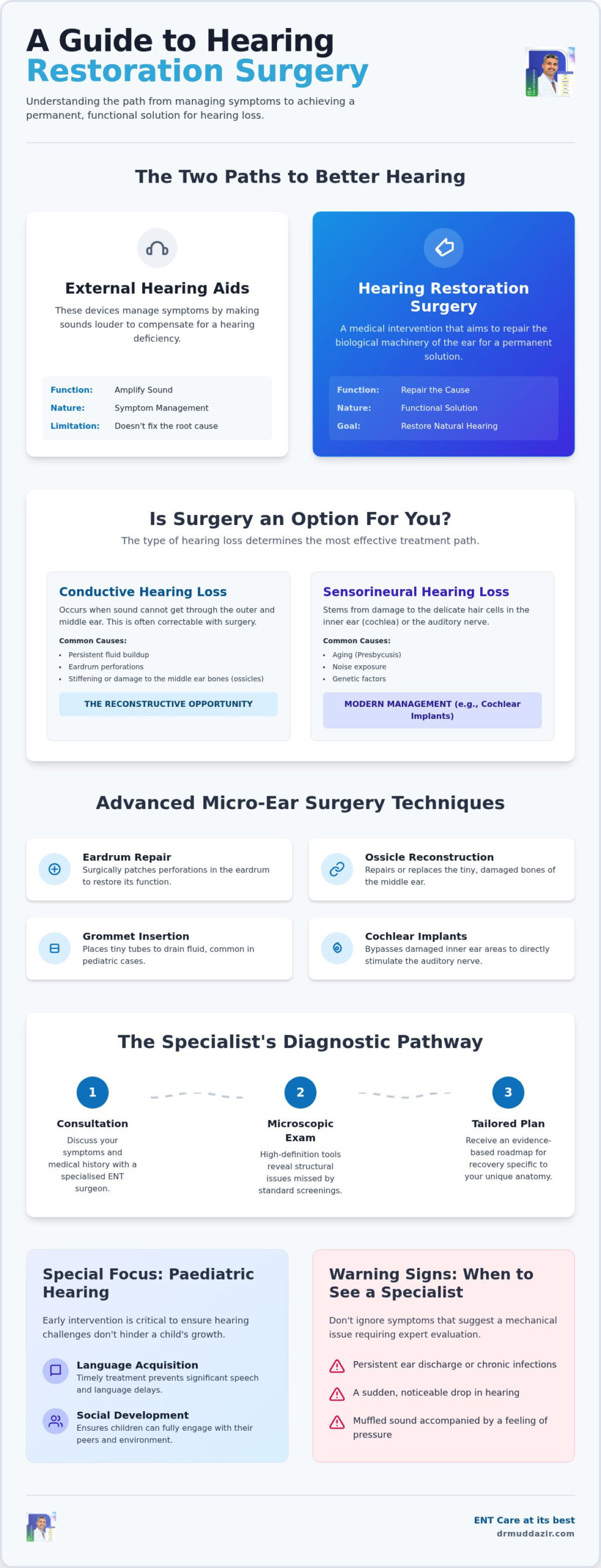
Do you find yourself constantly asking others to repeat themselves, or does the world feel like it’s being muffled by an invisible barrier? Many people assume that hearing loss is an inevitable part of ageing that can only be managed with external devices. However, hearing restoration surgery offers a transformative alternative by addressing the underlying physical causes of impairment. While hearing aids amplify sound to compensate for a deficiency, surgical intervention aims to repair the biological machinery itself.
Hearing restoration surgery is a specialised microscopic intervention designed to correct mechanical defects within the auditory system to re-establish natural sound conduction. For patients with conductive hearing loss, this means moving beyond temporary fixes toward a permanent improvement in auditory clarity. Addressing these issues early is vital. Clinical evidence suggests that untreated hearing loss can lead to cognitive decline in adults and significant speech delays in children, making timely intervention a priority for long-term health.
The Auditory Pathway: How We Process Sound
Sound travels through a complex three-part system: the outer, middle, and inner ear. Most surgical candidates experience issues in the middle ear, where the eardrum and three tiny bones, known as ossicles, work together to amplify vibrations. When mechanical blocks occur, such as fluid buildup or stiffening of these bones, the signal never reaches the inner ear properly. In cases where the inner ear is severely damaged, advanced technology like a Cochlear implant may be used to bypass the damaged areas and stimulate the auditory nerve directly.
When to Consult a Specialised ENT Surgeon
How do you know if your condition requires more than a standard hearing aid? Certain warning signs suggest a mechanical issue that needs the expertise of a British-trained consultant. You should seek a specialised evaluation if you experience:
- Persistent ear discharge or chronic infections that don’t resolve with standard treatments.
- A sudden, noticeable drop in hearing in one or both ears.
- Muffled sound quality accompanied by a persistent feeling of pressure in the ear canal.
A basic hearing test identifies what you can hear, but a microscopic ENT examination reveals why you can’t hear. Using high-definition microscopic tools, a surgeon can identify structural damage, such as a perforated eardrum or bone erosion, that a standard screening would miss. This level of precision ensures that the treatment plan is tailored to your specific anatomy, providing a clear roadmap toward recovery.
Conductive vs. Sensorineural Loss: When is Surgery an Option?
Many patients feel discouraged because they believe their hearing loss is simply “nerve damage” that can’t be fixed. This is a common misunderstanding that often prevents individuals from seeking effective medical help. Hearing loss is categorized by its physiological origin, and identifying this origin is the first step in determining if hearing restoration surgery is a viable path for you. It’s not a one-size-fits-all condition; rather, it’s a specific breakdown in a complex biological chain.
A consultant ENT surgeon plays a vital role in mapping the precise nature of your impairment. By using specialised diagnostic tools, they can determine whether your loss is conductive, sensorineural, or a combination of both, known as mixed hearing loss. This distinction is crucial. While some cases require management through technology, many others are rooted in mechanical issues that are surgically correctable. Understanding these differences helps replace anxiety with a clear, evidence-based plan for recovery.
Conductive Hearing Loss: The Reconstructive Opportunity
Conductive hearing loss occurs when sound vibrations cannot reach the inner ear efficiently. This is frequently caused by physical issues such as eardrum perforations, persistent fluid buildup, or the stiffening of the tiny bones in the middle ear. Because these are mechanical barriers, they represent a significant reconstructive opportunity. Through micro ear surgery, a surgeon can often fully reverse these conditions by repairing the eardrum or replacing a non-functioning bone. This restores the ear’s natural ability to conduct sound, often eliminating the lifelong dependence on external hearing devices.
Sensorineural Hearing Loss: Modern Management
This type of loss stems from damage to the delicate hair cells within the cochlea or the auditory nerve itself. Common causes include noise trauma, certain medications, or the natural effects of ageing. While these nerve-related issues were once considered untreatable, modern medicine has changed the narrative. For those with severe to profound loss, a specialist may recommend advanced interventions. You can find authoritative information on cochlear implants from the NIDCD, which explains how these devices bypass damaged sections of the ear to provide direct stimulation to the brain.
Whether your struggle is with a mechanical blockage or a more complex nerve issue, the goal is always to protect your remaining hearing and improve your quality of life. If you are experiencing muffled sounds or difficulty following conversations, a consultation with a British-trained ENT specialist can help you identify the root cause and explore your surgical options.
Advanced Micro Ear Surgery for Hearing Restoration
Modern microscopic techniques have revolutionised the field of auditory medicine. While some academic discussions focus on distant future therapies, advanced hearing restoration surgery provides immediate and highly successful solutions for those suffering from mechanical ear conditions. By utilising high-powered surgical microscopes, a consultant ENT surgeon can operate with extreme precision, often through the ear canal itself. This minimally invasive approach focuses on repairing the delicate structures of the middle ear, allowing many patients to regain their natural hearing and move away from a lifelong reliance on external aids.
The patient experience during these specialised procedures is designed to be as comfortable and reassuring as possible. Most micro ear surgeries are performed under general anaesthesia, ensuring you remain completely still while the surgeon works on structures often smaller than a grain of rice. Recovery is typically efficient; many patients return home on the same day or after a short observation period, feeling a renewed sense of security about their auditory health.
Tympanoplasty: Repairing the Eardrum
If you’ve suffered from chronic ear infections or a perforation that hasn’t healed, a tympanoplasty may be the solution. This procedure involves using a small tissue graft to reconstruct a healthy and vibrating eardrum. A successful repair doesn’t just improve sound clarity. It also creates a “water-safe” ear, meaning you can return to swimming and bathing without the constant fear of recurring infections or discomfort.
Stapes Surgery for Otosclerosis
Otosclerosis is a condition where the stapes, the smallest bone in the human body, becomes fixed and unable to vibrate. Stapes surgery can restore hearing to near-normal levels in patients with otosclerosis. During this microscopic procedure, the immobile bone is removed and replaced with a tiny, high-tech prosthesis. This restores the natural sound transmission chain, often resulting in a dramatic improvement in hearing that patients notice almost immediately after the surgical packing is removed.
Ossiculoplasty: Rebuilding the Sound Chain
When trauma or chronic infection damages the three tiny bones of the middle ear, the sound signal cannot reach the inner ear effectively. Ossiculoplasty involves repairing or replacing these bones using specialised prosthetics designed to bridge the gaps in the auditory chain. These microscopic components are engineered to mimic the natural movement of healthy ear bones. Recovery milestones usually involve a series of follow-up audiometry tests to track your progress as the ear heals and your auditory clarity returns to its full potential.
Paediatric Hearing Solutions: Specialized Care for Children
For a developing child, clear hearing is the essential foundation for language acquisition and social milestones. When a child struggles to hear, they don’t just miss out on sounds; they miss the nuances of human connection and the building blocks of communication. In many cases, children who seem inattentive, struggle in school, or appear “naughty” are actually dealing with a “hidden” hearing loss. This is often a mechanical issue that can be corrected through specialised paediatric interventions, preventing long-term developmental delays.
A compassionate, gentle approach is vital during paediatric ENT examinations. Children often feel anxious about medical visits, so building trust is the first step toward a successful outcome. It’s also important to recognise that ear health is rarely an isolated issue. The ears, nose, and throat are part of a single, interconnected system. Just as endoscopic sinus surgery addresses blocks in the nasal passages, paediatric ear procedures focus on clearing the pathways that allow for natural sound conduction. When these pathways are restored, the child’s world opens up almost instantly.
Grommet and Ventilation Tube Insertion
One of the most common causes of paediatric hearing impairment is “Glue Ear,” a condition where thick fluid builds up behind the eardrum. This fluid acts as a sound barrier, making the child feel as though they are underwater. Grommet insertion is a highly effective form of hearing restoration surgery for children. These tiny tubes are placed in the eardrum to equalise pressure and allow the middle ear to “breathe,” which drains the fluid naturally. Parents often report an immediate “wow” effect, noting that their child’s speech and responsiveness improve within days of the procedure.
The Adenoid-Ear Connection
Why do some children suffer from recurring ear fluid? Often, the culprit is the adenoids. These are patches of tissue at the back of the throat that, when enlarged, can physically block the Eustachian tube. This tube is the bridge that drains fluid from the ear to the throat. When it’s blocked, fluid becomes trapped, leading to chronic infections and muffled hearing. In these instances, a combined approach of adenoidectomy and grommet insertion is often the best pathway to ensure the ear remains clear long-term.
Post-operative care for children is designed to be fear-free and straightforward. Most kids are back to their normal activities quickly, often with a renewed enthusiasm for learning and play. If you’ve noticed your child turning up the television or failing to respond when called, it’s time to act. You can schedule a specialised paediatric consultation to ensure your child’s hearing is on the right track for their development.
Preparing for Your Journey: Consultation and Recovery
Deciding to undergo hearing restoration surgery is a significant milestone in your health journey. It’s natural to feel a mix of hope and apprehension about the process. To ensure the highest standard of safety and success, choosing a British-trained specialist is essential. This clinical background ensures your care is rooted in rigorous, evidence-based surgical protocols developed over years of specialised experience. You aren’t just a case file; you’re a partner in a clinical process designed to return your world to full volume. Collaborative decision-making is at the heart of this journey, where we’ll discuss whether surgery or conservative management is the most effective path for your specific auditory goals.
The Diagnostic Pathway at a Specialised ENT Clinic
The journey begins with advanced audiological mapping. This goes beyond identifying what sounds you miss by pinpointing exactly where the auditory chain has failed. Following this, a microscopic ear inspection is conducted. Unlike basic hand-held scopes used in general practice, high-definition surgical microscopy allows the consultant to see deep-seated pathology, such as bone erosion or subtle membrane thinning, that basic tools miss. These findings allow for a bespoke treatment plan tailored to your specific lifestyle needs, ensuring the intervention matches your daily environment.
Life After Hearing Restoration Surgery
Recovery timelines vary depending on the complexity of the procedure, but many patients return to non-strenuous work within one to two weeks. While air travel is usually restricted for a short period to allow middle ear pressure to stabilise, you’ll receive a clear, step-by-step roadmap for your return to normal activities. The emotional impact of the surgery is often its most profound result. Reconnecting with the laughter of loved ones or the subtle sounds of nature provides a sense of security and joy that is difficult to quantify.
Long-term auditory health requires consistent protection. Once your hearing is restored, your specialist will guide you on how to safeguard these results through regular check-ups and noise management. This commitment ensures that the precision of your surgery translates into a lifetime of clear, effortless communication.
Schedule a specialist consultation for hearing restoration with Dr. Muddazir Ibrahim to begin your diagnostic journey toward auditory clarity today.
Reclaiming Your Connection to Sound
Restoring your hearing is about more than just physical repair; it’s about reconnecting with the people and experiences that matter most. We’ve explored how identifying the mechanical cause of loss is the first step toward a permanent solution. Whether it’s through repairing a perforated eardrum or replacing a fixed stapes bone, modern hearing restoration surgery offers a level of precision that was once unimaginable. For children, these interventions are even more critical, ensuring that “Glue Ear” or adenoid issues don’t stand in the way of their developmental milestones.
When you’re ready to move beyond managing symptoms and toward a functional cure, the guidance of a seasoned expert is invaluable. Dr. Muddazir Ibrahim brings over 15 years of clinical experience as a British-trained ENT consultant specialising in advanced micro-ear surgery. By choosing an evidence-based diagnostic pathway, you’re ensuring that your treatment is as unique as your anatomy. Don’t let silence define your future. Consult a Specialised ENT Surgeon for Hearing Restoration today to explore your options and take the first step toward auditory clarity. Your journey to better hearing starts with a single, expert consultation.
Frequently Asked Questions
Is hearing restoration surgery safe for older adults?
Age itself isn’t a barrier to hearing restoration surgery, as the primary consideration is the patient’s overall health and suitability for anaesthesia. Many older adults experience significant improvements in their social engagement and cognitive health after reconstructive procedures. Since these surgeries are often minimally invasive and performed microscopically, the physical strain is typically well-tolerated. A thorough pre-operative assessment ensures that the benefits of improved auditory function outweigh any surgical risks.
How long is the recovery period after micro ear surgery?
Most patients can return to non-strenuous work or school within one to two weeks following a microscopic ear procedure. While the external incision, if any, heals quickly, the internal structures require more time to stabilise. You’ll typically need to avoid heavy lifting, vigorous exercise, and air travel for approximately four to six weeks. Your surgeon will provide a specific timeline based on the complexity of your reconstruction and your individual healing progress.
Can hearing loss caused by loud noise be fixed with surgery?
Hearing loss resulting from noise trauma is typically sensorineural; this involves damage to the delicate hair cells in the inner ear rather than a mechanical block. Surgery is generally designed to repair the conductive mechanisms of the middle ear. While noise-induced loss cannot be fixed with traditional reconstructive surgery, patients with profound damage may be candidates for advanced technology like cochlear implants. Protecting your remaining hearing through specialised care is a priority.
Will my child need general anaesthesia for grommet insertion?
Yes, children require general anaesthesia for grommet or ventilation tube insertion to ensure they remain completely still during the procedure. This allows the surgeon to use a high-powered microscope to make a precise, microscopic incision in the eardrum. The procedure is brief, usually lasting about 15 to 20 minutes, and is performed as a day case. This approach minimises stress for the child and ensures the highest level of surgical accuracy for their developing ears.
What is the success rate of stapes surgery for restoring hearing?
Stapes surgery is considered one of the most successful procedures in the field of hearing restoration surgery, with over 90% of patients experiencing a significant improvement in their auditory clarity. By replacing a fixed, non-vibrating bone with a microscopic prosthesis, the natural sound conduction chain is restored. While every surgical outcome depends on individual anatomy, most patients find that the procedure effectively bridges the gap between muffled sound and clear, natural communication.
Can chronic ear infections lead to permanent hearing loss if untreated?
Chronic infections can cause permanent damage by eroding the tiny bones of the middle ear or creating lasting perforations in the eardrum. Over time, persistent inflammation may lead to “Glue Ear” or the development of a cholesteatoma, a non-cancerous skin growth that can damage surrounding structures. Early intervention through micro ear surgery can often repair this damage and prevent the progression toward irreversible sensory loss, preserving your long-term auditory health and quality of life.
How do I know if I need a hearing aid or surgery?
The choice between a hearing aid and surgery depends entirely on whether your loss is conductive or sensorineural. A hearing aid amplifies sound to compensate for nerve-related decline; surgery aims to repair the physical structures responsible for sound transmission. A specialised diagnostic pathway, including high-definition microscopy and advanced audiometry, is required to identify the root cause. If a mechanical block is found, surgery often provides a more permanent, functional solution than external amplification.
Is eardrum repair surgery painful during the recovery phase?
Most patients report only mild discomfort or a sensation of “fullness” in the ear rather than significant pain following a tympanoplasty. This is typically well-managed with standard over-the-counter analgesics for the first few days. You might experience occasional popping or clicking sounds as the internal packing dissolves and the ear heals. Your surgical team will provide detailed aftercare instructions to ensure your recovery is as comfortable and reassuring as possible during the healing process.