
What if the nasal sprays and antihistamines you rely on every night aren’t failing because your allergies are worsening, but because your airway is physically blocked? When structural deformities narrow the nasal passage, medication can only offer temporary comfort. For individuals enduring disrupted sleep, chronic dry mouth, and an inability to breathe freely through both nostrils, nasal congestion relief surgery provides an anatomical solution when conservative medical therapies fail to restore airflow.
It’s exhausting to face persistent obstruction day after day, particularly when over-the-counter sprays create a frustrating cycle of rebound congestion. You deserve a clear, clinical understanding of what is happening inside your airway. In this guide, you’ll learn how specific procedures address internal blockages, how ENT specialists identify viable surgical candidates, and what to expect during diagnostic evaluation and the subsequent recovery process.
Key Takeaways
- Understand the difference between temporary mucosal swelling and fixed structural blockages that cannot be resolved with medication alone.
- Discover how specific forms of nasal congestion relief surgery, including Septoplasty and Turbinate surgery, target individual anatomical obstructions.
- Learn why Diagnostic nasal endoscopy is an essential clinical assessment for evaluating nasal passages prior to any procedural recommendation.
- Gain clarity on modern perioperative standards, gentle anesthesia protocols, and packing-free techniques that support postoperative recovery.
- Identify when persistent breathing difficulties warrant an in-person clinical evaluation with an ENT specialist in Dubai.
Understanding Chronic Nasal Congestion: When Structural Obstruction Requires Intervention
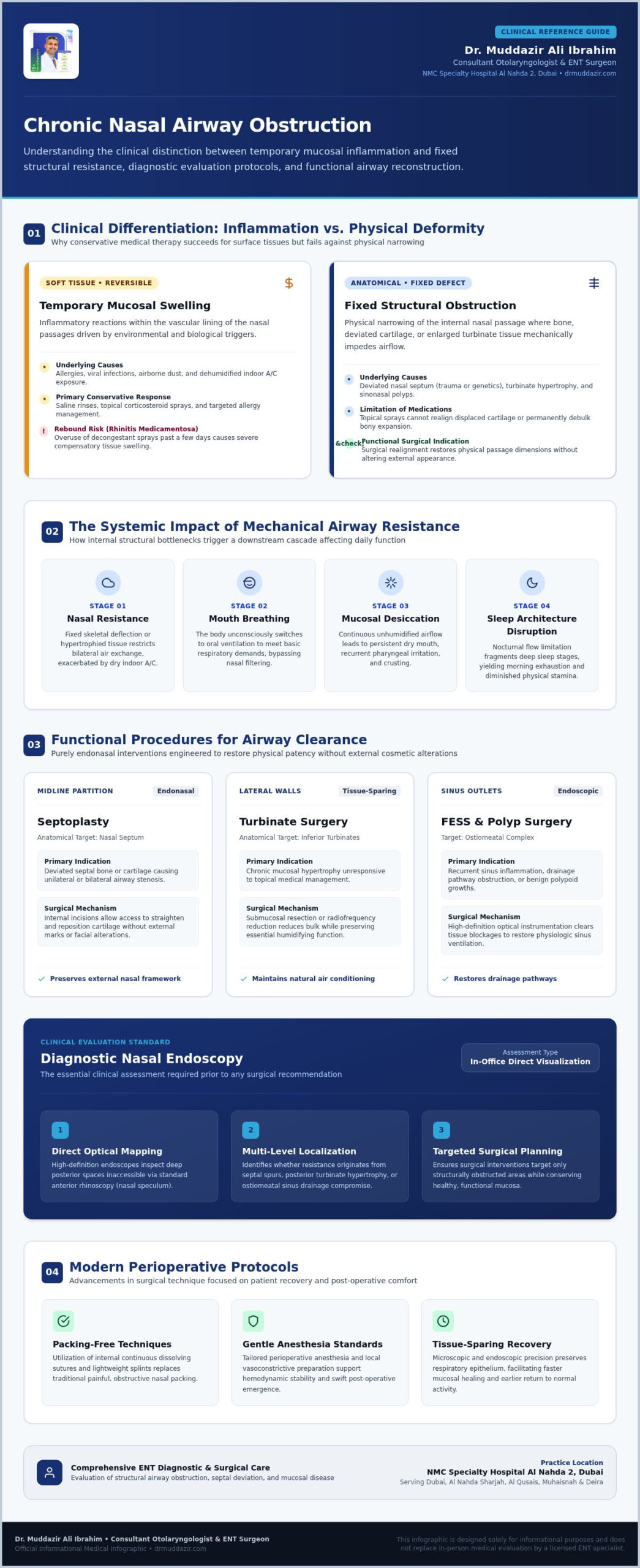
Chronic nasal obstruction is defined as persistent mechanical resistance within the nasal airway that hinders normal breathing. While acute congestion typically stems from temporary mucosal inflammation due to viral infections or allergies, structural obstruction involves fixed anatomical narrowing. In regional environments like Dubai, airborne dust and continuous exposure to dehumidified air conditioning frequently aggravate these restricted spaces. When an airway is already compromised by bone or cartilage deviations, dry air accelerates mucosal irritation and crusting.
Many patients initially turn to over-the-counter decongestant sprays for rapid symptom relief. However, using these sprays beyond a few consecutive days can trigger rhinitis medicamentosa, a rebound condition that causes worsening tissue swelling once the spray wears off. When medical options fail to provide lasting airflow, functional nasal congestion relief surgery serves as an anatomical correction to normalize the nasal passage, focusing entirely on airway function rather than cosmetic modification.
Medical Management vs. Structural Airway Narrowing
First-line management for nasal blockage typically includes saline rinses, topical corticosteroid sprays, and targeted allergy protocols. While these treatments help reduce surface mucosal swelling, they cannot realign displaced bone or crooked cartilage. When physical bottlenecks exist, topical sprays cannot properly distribute across targeted tissues. In cases where structural deviation impedes breathing, functional interventions such as septoplasty surgery are designed to reposition the internal partition and restore physical patency.
The Functional Impact of Chronic Airway Blockage
Living with persistent airway blockage affects far more than daytime comfort. Chronic nasal resistance forces compensatory mouth breathing, which frequently causes chronic dry mouth, persistent throat irritation, and disrupted sleep. Over time, restricted nighttime breathing can lead to morning fatigue and reduced exercise stamina. If you notice ongoing nasal obstruction that doesn’t resolve or constant unilateral blockage, an in-person clinical evaluation with an ENT specialist may be appropriate to assess your internal nasal anatomy.
Types of Nasal Congestion Relief Surgery: Procedures for Airway Clearance
When anatomical narrowing resists medical therapies, nasal congestion relief surgery aims to reconstruct internal airflow channels. Unlike cosmetic procedures, these functional operations occur entirely inside the nasal cavity to preserve external facial features while correcting structural resistance. Because patients often experience multi-level blockages, addressing both the midline partition and lateral nasal tissues is frequently necessary to restore unhindered breathing.
Here is how the primary functional procedures compare:
- Septoplasty: Targets the nasal septum; indicated for deviated bone or cartilage; realigns the central partition.
- Turbinate surgery: Targets the inferior turbinates; indicated for chronic mucosal enlargement; reduces tissue volume while preserving humidifying function.
- Functional Endoscopic Sinus Surgery (FESS) and Nasal polyp surgery: Targets the ostiomeatal complex and sinus cavities; indicated for chronic inflammation and benign growths; clears obstructed drainage pathways.
Septoplasty: Straightening the Deviated Nasal Septum
The nasal septum is the central partition separating your left and right nasal passages. When this partition deviates off-center due to genetics or previous trauma, it creates continuous mechanical resistance in one or both nostrils. During a Septoplasty, the surgeon accesses deviated cartilage and bone through internal incisions, straightening and repositioning the septum without leaving external marks. You can review our detailed Septoplasty Surgery in Dubai: 2026 Patient Guide to explore specific surgical techniques.
Turbinate Surgery: Reducing Enlarged Inferior Turbinates
Inferior turbinates are curved bony structures along the side walls of your nasal passages that warm and humidify incoming air. In response to recurring environmental irritants, their mucosal lining can become chronically swollen, a state known as turbinate hypertrophy. Turbinate surgery utilizes tissue-sparing techniques, such as submucosal resection or radiofrequency reduction, to shrink excess volume without compromising mucosal moisture. During an in-clinic diagnostic nasal endoscopy, an otolaryngologist directly assesses turbinate size to see if concurrent reduction is needed alongside septal straightening.
Functional Endoscopic Sinus Surgery (FESS) and Nasal Polyp Surgery
Chronic inflammation can also lead to mucosal swelling or benign growths called nasal polyps, which obstruct delicate sinus drainage channels. Through Functional Endoscopic Sinus Surgery (FESS), an ENT surgeon uses micro-telescopes to open blocked pathways and re-establish natural ventilation. When polyps occupy the airway, targeted Nasal polyp surgery removes the obstructing tissue directly. If persistent congestion disrupts your daily routine, scheduling a clinical consultation with Dr. Muddazir Ali Ibrahim at NMC Specialty Hospital Al Nahda 2, Dubai, can clarify which procedural approach matches your symptoms.
Diagnostic Nasal Endoscopy: Determining Your Surgical Candidacy
Determining whether someone requires surgery follows a systematic clinical pathway. Because external symptoms like congestion and mouth breathing overlap across various conditions, an ENT surgeon uses a methodical four-step assessment to identify the exact cause of airway resistance:
- Step 1: Clinical history documentation: Detailed review of symptom duration, seasonal patterns, sleep quality, and responses to previous nasal sprays or allergy therapies.
- Step 2: External examination and anterior rhinoscopy: Assessment of external nasal architecture, structural support, and the internal nasal valve.
- Step 3: Diagnostic nasal endoscopy: High-definition visualization of internal anatomy, turbinate volume, and sinus drainage pathways.
- Step 4: Objective imaging review: High-resolution, non-contrast computed tomography (CT) scans when chronic sinus disease or complex anatomical variants require deeper evaluation.
What Diagnostic Nasal Endoscopy Reveals to the ENT Surgeon
While anterior rhinoscopy provides a quick look at the nasal vestibule, it cannot visualize the deeper recesses of the nasal cavity. Diagnostic nasal endoscopy bridges this gap. Using a slender, illuminated fiber-optic instrument, the surgeon examines the entire passage after applying a gentle topical decongestant and local anesthetic spray. This in-office evaluation allows direct inspection of deep posterior septal spurs, subtle mucosal polyps, or hidden purulent secretions that standard exams miss. By assessing how real-time airflow behaves across structural landmarks, the specialist precisely identifies mechanical resistance points.
Identifying Candidates for Airway Surgery
Surgical intervention is indicated when an identifiable anatomical obstruction correlates directly with persistent symptoms that fail to resolve with conservative medical therapy. For individuals dealing with a blocked nose all the time, finding out whether the issue stems from bone, cartilage, or soft tissue is the primary objective of clinical evaluation. When mechanical deformities impede airflow, targeted surgical correction of a deviated septum or turbinate reduction can physically restore patency. Every surgical candidate receives an individualized treatment plan based strictly on physical findings rather than generalized symptom profiles, ensuring that nasal congestion relief surgery addresses only the exact structures causing blockage.
What to Expect: Procedural Steps, Anesthesia, and Post-Operative Recovery
Understanding the perioperative pathway helps dispel common anxieties surrounding functional nasal procedures. Modern nasal congestion relief surgery is typically performed under general anesthesia as an elective day-care procedure in an acute hospital surgical facility. Patients are admitted, undergo their planned operation, and return home once fully alert and stable under structured discharge protocols.
Outdated fears about extensive post-operative discomfort usually stem from historical memories of non-absorbable gauze packing. Today, advanced techniques emphasize mucosal preservation, internal quilting sutures, and dissolvable supportive biomaterials. These modern methods support tissue alignment without the painful removal process once associated with traditional nasal packs.
The Surgical Experience: Inside the Operating Theatre
During Septoplasty and Turbinate surgery, surgical entry occurs entirely through internal nostrils. This functional approach leaves no visible external cuts, changes to external facial contours, or bruising beneath the eyes. Using high-definition endoscopic visualization, the surgeon works with fine micro-instrumentation to reshape deviated cartilage, trim isolated bony spurs, or reduce enlarged submucosal layers while carefully preserving surrounding respiratory epithelium.
The Recovery Journey and Aftercare Principles
Initial sensations after surgery often mimic having a head cold. Patients typically experience temporary nasal fullness, light blood-tinged drainage, and mild facial pressure. These symptoms are normal physiological responses to tissue manipulation and gradual healing:
- Gentle saline irrigation: Regular rinsing with sterile saline flushes away dried mucus and supports mucosal regeneration.
- Activity modifications: Strenuous exercise, heavy lifting, and forceful nose blowing must be paused to avoid premature bleeding.
- Scheduled clinical follow-up: In-office cavity checks ensure appropriate healing, gentle crust removal, and confirmation of restored airway patency.
Adhering closely to the personalized postoperative instructions provided by your clinical team is vital for uncompromised recovery. If you are ready to assess your structural airway health, you can schedule a comprehensive consultation with Dr. Muddazir Ali Ibrahim at NMC Specialty Hospital Al Nahda 2, Dubai.
Navigating ENT Evaluation in Dubai and Northern Emirates
Living in the UAE presents specific environmental challenges for the upper respiratory tract. Prolonged indoor exposure to dehumidified air conditioning combined with ambient desert dust and airborne sand can place continuous stress on nasal passages. When structural narrowing is already present, these atmospheric factors compound resistance, causing chronic inflammation and dryness. Understanding how Dubai’s climate affects sinus health helps patients distinguish between weather-induced irritation and true mechanical obstruction requiring nasal congestion relief surgery.
When to Seek Specialist ENT Consultation
While occasional stuffiness is expected during seasonal transitions, certain symptoms warrant a focused clinical examination. You should consider consulting an otolaryngologist if your airway obstruction exhibits any of the following patterns:
- Blockage localized predominantly to one nostril that never alternates or clears.
- Chronic congestion that remains unchanged after four to six weeks of prescribed medical sprays.
- Frequent dependence on over-the-counter decongestants to breathe or sleep comfortably.
- Recurring facial pressure, headaches, or unrefreshing sleep caused by persistent mouth breathing.
Reviewing these signs you need to see an ENT doctor can clarify when home remedies are no longer adequate and an in-person assessment is necessary.
Specialist Care at NMC Specialty Hospital Al Nahda 2
For individuals seeking clarity regarding persistent breathing issues, comprehensive clinical assessments are available with Dr. Muddazir Ali Ibrahim, Consultant Otolaryngologist & ENT Surgeon at NMC Specialty Hospital Al Nahda 2, Dubai. The clinic provides accessible diagnostic and surgical care for patients residing across Dubai, Al Nahda Dubai, Al Nahda Sharjah, Sharjah, Al Qusais, Muhaisnah, and Deira.
Every clinical pathway begins with high-definition Diagnostic nasal endoscopy to visualize the exact anatomy of the septum, turbinates, and sinus ostia. By confirming whether your symptoms stem from mucosal swelling, cartilaginous deviation, or polyps, the surgical team formulates a patient-centered plan. If functional nasal congestion relief surgery is clinically indicated, care is delivered using contemporary, tissue-sparing techniques designed to restore natural nasal airflow and support long-term respiratory well-being.
Taking the Next Step Toward Clear Breathing
Living with ongoing nasal resistance drains your daily energy, disrupts restorative sleep, and creates frustrating dependence on temporary decongestants. When conservative medical measures can’t overcome physical deviations or turbinate enlargement, nasal congestion relief surgery provides a precise, anatomical solution. Contemporary functional procedures prioritize tissue preservation and packing-free techniques, focusing entirely on re-establishing natural airway physiology without altering your external facial profile.
A definitive diagnosis begins with high-definition visual assessment. As a Consultant Otolaryngologist, Dr. Muddazir Ali Ibrahim provides comprehensive diagnostic nasal endoscopy and functional surgical care at NMC Specialty Hospital Al Nahda 2, Dubai. If chronic obstruction is holding you back, you can take control of your respiratory health and consult Dr. Muddazir Ibrahim to explore an individualized clinical plan designed to help you breathe freely and rest comfortably once again.
Frequently Asked Questions
How do I know if my nasal congestion requires surgery rather than medication?
Surgery is typically considered when chronic obstruction is caused by a verified anatomical obstacle that fails to respond to conservative medical therapies. If topical corticosteroid sprays, saline rinses, or antihistamines bring no meaningful relief after consistent use, the blockage is usually physical rather than allergic. An in-office evaluation and diagnostic nasal endoscopy can confirm whether nasal congestion relief surgery is suitable to correct deviated bone, cartilage, or soft tissue.
Is surgery for nasal congestion painful, and will my face be bruised?
Functional airway procedures are performed entirely through the nostrils, which prevents external facial bruising or visible swelling around your eyes. Postoperative discomfort is generally mild to moderate and effectively controlled with prescribed medication. Advanced surgical techniques prioritize mucosal preservation and utilize dissolvable support materials or internal sutures rather than traditional, non-absorbable gauze packing, ensuring a far gentler and more tolerable recovery experience.
What is the difference between septoplasty and turbinate surgery?
Septoplasty straightens the central partition of cartilage and bone dividing your nostrils, whereas turbinate surgery reduces the swollen mucosal structures along the side walls of your nasal passages. A deviated septum creates fixed unilateral or bilateral mechanical resistance. Turbinate hypertrophy involves enlarged tissue that restricts airflow. ENT surgeons frequently combine both procedures during the same operative session to resolve multi-level obstruction simultaneously.
Can functional nasal surgery improve my sleep apnea or snoring?
Functional nasal procedures can significantly decrease upper airway resistance, which helps minimize mouth breathing, alleviates dry throat symptoms, and may reduce snoring intensity. While structural nasal blockage is rarely the sole cause of obstructive sleep apnea, it frequently makes nighttime breathing devices difficult to tolerate. Correcting internal blockages improves overall respiratory dynamics and helps patients use sleep apnea therapies, such as CPAP masks, much more comfortably.
Will my insurance cover surgery for nasal obstruction?
Most health insurance policies across Dubai and the UAE offer coverage for functional nasal operations when they are deemed medically necessary to restore compromised breathing. Approval generally requires clinical documentation demonstrating structural obstruction unresponsive to appropriate medical management. Because policy terms, deductibles, and pre-authorization criteria differ across networks, coverage details should be verified directly with hospital insurance coordinators during your consultation at NMC Specialty Hospital Al Nahda 2, Dubai.
Can nasal congestion return after functional airway surgery?
Cartilage and bone straightened during surgery remain permanently realigned, but surrounding mucosal linings can still react to environmental triggers. Regional factors like dust, humidity fluctuations, and prolonged air conditioning can cause temporary swelling or allergic irritation. Undergoing nasal congestion relief surgery removes structural bottlenecks, though occasional saline rinses or topical sprays may still be recommended to support mucosal hygiene and maintain long-term nasal comfort.
How long will I need to rest before returning to work after nasal surgery?
Rest periods vary based on the specific surgical procedure performed and the physical demands of your daily employment. Many patients resuming desk-based work return once initial light drainage and fatigue have settled down. However, activities involving strenuous exertion, heavy lifting, or vigorous sports should be avoided for several weeks to prevent elevated blood pressure, reduce bleeding risks, and allow fragile internal tissues to heal smoothly.