
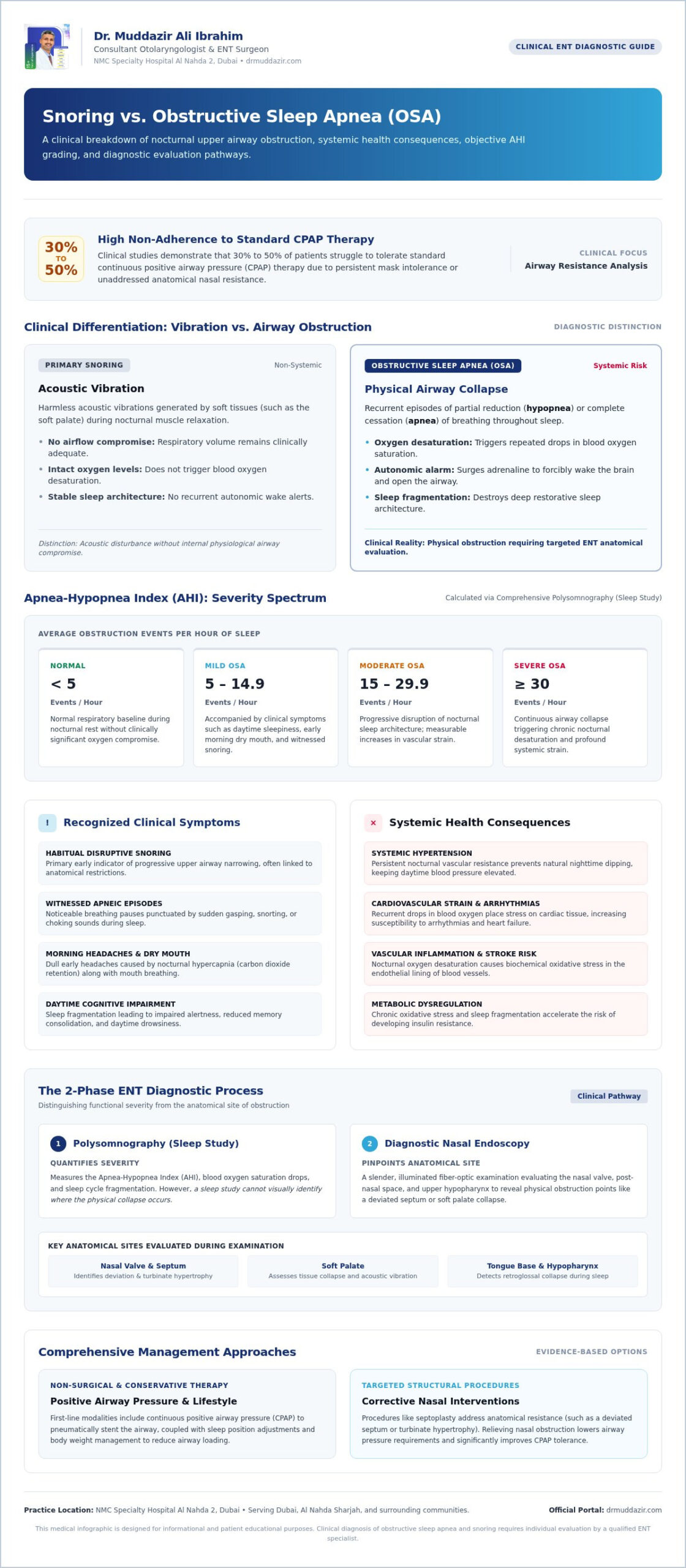
Clinical studies show that between 30% and 50% of patients struggle to tolerate standard CPAP therapy, leaving them trapped in a cycle of broken rest. If loud snoring disrupts your partner and you wake unrefreshed despite spending eight hours in bed, seeking an effective sleep apnea treatment isn’t just about restoring quiet nights; it is vital for safeguarding your long-term cardiovascular health.
It’s entirely natural to feel frustrated by persistent fatigue and anxious about the strain that nocturnal airway collapse places on your heart. Living with fragmented sleep takes a heavy physical toll, yet enduring cumbersome masks without investigating the anatomical cause of your symptoms isn’t your only path forward.
This specialist guide explains the clinical diagnostic pathways and treatment options available in Dubai, from a comprehensive Snoring/OSA evaluation to targeted procedures that relieve structural airway resistance. You’ll gain a clear understanding of how ENT specialists identify the exact site of obstruction, allowing you to evaluate non-surgical therapies alongside surgical solutions to restore quiet, healthy breathing.
Key Takeaways
- Understand the clinical distinctions between benign primary snoring and obstructive sleep apnea to recognize when airway collapse threatens systemic health.
- Learn how an in-depth Snoring/OSA evaluation uses diagnostic nasal endoscopy to pinpoint the exact structural site of nighttime obstruction.
- Discover how a comprehensive sleep apnea treatment plan balances conservative approaches, such as CPAP and lifestyle changes, with targeted anatomical solutions.
- Explore how corrective nasal procedures like septoplasty can reduce upper airway resistance, especially for individuals who struggle with positive airway pressure therapy.
- Find out how specialist ENT consultations at NMC Specialty Hospital Al Nahda 2 provide accessible care for patients across Dubai and the Sharjah border communities.
Understanding Obstructive Sleep Apnea (OSA) and Its Health Risks
When muscle relaxation during sleep causes the soft tissues of the throat and upper airway to collapse, normal airflow stops. Clinically recognized as obstructive sleep apnea, this condition leads to recurrent episodes of partial reduction (hypopnea) or complete cessation (apnea) of breathing throughout the night. Unlike benign primary snoring, which involves harmless acoustic vibrations of the soft palate without airflow compromise, OSA triggers repeated drops in blood oxygen saturation and disrupts restorative sleep architecture.
Obstructive sleep apnea represents a serious physical obstruction within the upper respiratory tract that requires a specialist ENT evaluation for accurate diagnosis. When air cannot reach the lungs, the autonomic nervous system sounds an internal alarm, spiking adrenaline and forcing the brain to briefly wake to reopen the airway.
Over time, this nocturnal turbulence takes a substantial toll on overall wellness. The primary systemic health risks associated with OSA include:
- Systemic hypertension: Persistent nocturnal vascular resistance often causes blood pressure to remain dangerously elevated throughout the day.
- Cardiovascular strain: Recurrent oxygen drops increase susceptibility to nocturnal cardiac arrhythmias and heart failure.
- Daytime cognitive impairment: Sleep fragmentation impairs executive function, memory consolidation, alertness, and workplace focus.
Common Symptoms You Should Never Ignore
Habitual, disruptive snoring is often the earliest indicator of progressive upper airway narrowing, especially when paired with anatomical factors like a deviated septum or turbinate hypertrophy. Partners frequently notice witnessed apneas, describing distressing pauses in breathing punctuated by sudden gasping, snorting, or choking sounds. During the day, patients often struggle with dull morning headaches caused by nocturnal hypercapnia (carbon dioxide retention), alongside chronic dry mouth, brain fog, and overwhelming daytime drowsiness.
The Long-Term Impact of Untreated OSA
Repeated nocturnal oxygen desaturation places the endothelial lining of blood vessels under severe oxidative stress. This biochemical injury accelerates vascular inflammation and metabolic dysregulation, substantially increasing the long-term risk of insulin resistance and stroke. Exploring 10 Surprising Facts About Obstructive Sleep Apnoea Osa reveals just how deeply systemic this airway disorder can become.
Early clinical intervention remains essential for stabilizing metabolic and cardiovascular function. Pursuing targeted sleep apnea treatment relieves chronic strain on the heart, restores normal oxygen transport, and allows your vital organs to recover through uninterrupted rest.
The Specialist Diagnostic Process: Snoring and OSA Evaluation
Arriving at an accurate diagnosis begins with a meticulous clinical history rather than immediate device prescription. During an initial consultation, an ENT surgeon evaluates daytime fatigue patterns, sleep positioning, body mass index, and cardiovascular history. Pinpointing whether respiratory resistance originates in the nasal valve, the soft palate, or the tongue base ensures that subsequent sleep apnea treatment targets the authentic physiological blockage rather than merely addressing surface sounds.
A comprehensive sleep study (polysomnography) grades severity by calculating the Apnea-Hypopnea Index (AHI). This metric documents the average number of apneas and hypopneas occurring per hour of sleep:
- Normal: Fewer than 5 events per hour
- Mild OSA: 5 to 14.9 events per hour, accompanied by clinical symptoms
- Moderate OSA: 15 to 29.9 events per hour
- Severe OSA: 30 or more events per hour
Every clinical management pathway is strictly customized around these objective metrics, ensuring therapies correlate precisely with baseline respiratory demand.
Diagnostic Nasal Endoscopy in Dubai
While a sleep study quantifies apnea severity, it cannot show where tissues collapse. Diagnostic nasal endoscopy bridges this critical gap. Using a slender, illuminated fiber-optic instrument, the surgeon directly examines the internal nasal anatomy, post-nasal space, and upper hypopharynx while you are awake. This clinical visualization identifies structural impediments, including nasal septal deviations, turbinate hypertrophy, or redundant palatal tissues. Understanding anatomical drivers through a specialized clinical evaluation, as detailed in our guide to Snoring Treatment Dubai Causes Diagnosis Treatment, provides the clarity needed to select the correct anatomical intervention.
What to Expect During a Sleep Evaluation
Depending on clinical history and medical complexity, diagnostic testing involves either a home sleep apnea test (HSAT) or an in-lab polysomnography. Home monitors focus primarily on respiratory effort, nasal airflow, pulse rate, and peripheral arterial tonometry. In contrast, comprehensive hospital studies also track brain wave activity (EEG), eye movements, and limb gestures to differentiate obstructive events from central sleep disturbances.
These biometric recordings document continuous blood oxygen fluctuations and micro-arousals, establishing the foundational data required to explore evidence-based sleep apnea treatment options. If you live in Dubai or nearby Northern Emirates communities like Sharjah and suspect nocturnal airway collapse, you can schedule a specialized ENT consultation to begin building your personalized respiratory care plan.
Comparing Sleep Apnea Treatment Options: From Lifestyle to CPAP
Managing nocturnal airway collapse requires matching the therapeutic intervention to the severity of obstruction and individual patient anatomy. While medical literature often positions positive airway pressure as the gold standard, modern clinical care recognizes that no single therapy works for everyone. Navigating evidence-based approaches outlined in major clinical reviews on the diagnosis and treatment of sleep apnea helps clarify where conservative measures excel and where structural solutions become necessary.
For patients with mild to moderate disease who cannot tolerate pressurized masks, custom-fitted mandibular advancement devices (MADs) offer an alternative. These oral appliances reposition the lower jaw slightly forward during sleep, mechanically stabilizing the tongue base to keep the retroglossal airway patent.
When conservative interventions fall short, it’s typically because physical tissue resistance overpowers non-invasive mechanical support. Medical care must step beyond external devices when:
- Severe nasal blockage makes breathing through a mask impossible.
- The Apnea-Hypopnea Index remains elevated despite regular equipment use.
- Patients experience persistent oxygen desaturations due to multilevel pharyngeal collapse.
- Intolerance leads to abandonment of therapy altogether.
Lifestyle Adjustments and Their Limitations
Weight reduction plays a valuable role in decreasing adipose tissue around the neck and pharynx, reducing the compressive forces acting on the upper airway during muscle relaxation. Positional therapy, such as training oneself to sleep on the side using specialized pillows or wearable sensors, frequently mitigates gravity-induced tongue collapse in position-dependent apnea.
However, behavioral modifications cannot correct rigid anatomical impediments like a severely displaced nasal septum or hypertrophic tonsillar tissue. Lifestyle changes serve best as adjunctive strategies within a broader sleep apnea treatment plan rather than standalone cures for moderate-to-severe airway collapse.
The Role of CPAP Therapy
Continuous Positive Airway Pressure delivers a constant stream of ambient air through a facial or nasal interface. This pressurized airflow functions as a pneumatic splint, preventing soft tissues from collapsing into the respiratory tract. When used consistently, CPAP effectively normalizes the AHI and eliminates nighttime choking episodes.
Clinical practice benchmarks consider a patient adherent if they use the device for at least 4 hours per night on 70% of nights. Yet studies show 30% to 50% of patients fail to meet this threshold. Mask leaks, claustrophobia, and chronic mucosal drying present significant hurdles. Nasal passage resistance remains the most common obstacle; high nasal resistance forces machines to deliver higher pressures, increasing air leaks and making exhalation uncomfortable. Restoring unimpeded nasal airflow is often the essential missing link for successful, sustainable therapy.
Advanced Surgical Interventions for Sleep Apnea and Snoring
When external positive airway devices prove intolerable due to high airway resistance, ENT surgical interventions provide a viable path forward. Rather than acting as a universal cure on their own, functional airway surgeries fundamentally reconstruct the respiratory pathway to eliminate mechanical bottlenecks. Correcting these anatomical blockages reduces the physical effort needed to draw air into the lungs, directly stabilizing the pharyngeal tissues that vibrate or collapse during sleep.
For individuals with identifiable structural obstructions, procedural intervention forms an integral pillar of modern sleep apnea treatment. The primary surgical options target the nose, pharynx, or lymphoid tissue:
- Septoplasty: Straightening the central osteocartilaginous partition to balance airflow between both nasal passages.
- Turbinate surgery: Reducing chronic mucosal and bony enlargement of the inferior turbinates to lower overall nasal airway resistance.
- Adenotonsillectomy: Removing hypertrophic tonsils or adenoids, which represent the leading anatomical trigger of sleep apnea in children and select adults.
Correcting Nasal Obstruction: Septoplasty and Turbinate Surgery
The nasal passages account for more than half of total airway resistance. When a patient suffers from a deviated septum or chronically congested turbinates, the suction forces created during inhalation dramatically increase, pulling the downstream throat tissues inward. Straightening a deviated septum restores stable laminar airflow. Knowing when do you need endoscopic septoplasty surgery helps determine whether your persistent blockage warrants anatomical repair.
Turbinate surgery often accompanies septoplasty to expand the internal nasal valve. Beyond decreasing primary snoring intensity, establishing an open nasal pathway significantly lowers the pressure settings required for positive airway pressure devices, transforming previously unbearable therapies into comfortable, manageable routines.
Soft Palate and Throat Procedures
When dynamic collapse extends past the nose into the retroglossal or retropalatal space, targeted throat procedures may be indicated. In adults with excessive pharyngeal redundancy or tonsillar hypertrophy, surgical intervention widens the anatomical aperture and tensions lax lateral walls to minimize flutter. In pediatric care, adenotonsillectomy serves as the established first-line surgical standard, relieving pediatric airway narrowing with high clinical success.
Determining whether you are a suitable surgical candidate requires a comprehensive Snoring/OSA evaluation to map your obstruction pattern before choosing any procedure. To assess your structural airway anatomy with an experienced ENT surgeon, book an evaluation at our Dubai clinic today.
Specialized ENT Care at NMC Specialty Hospital Al Nahda 2
Effective management of sleep-disordered breathing requires precise anatomical insight paired with dedicated clinical oversight. Under the care of Dr. Muddazir Ibrahim, Consultant ENT Surgeon at NMC Specialty Hospital Al Nahda 2, Dubai, patients receive an individualized evaluation designed to isolate the physical contributors to airway narrowing. With over 15 years of clinical experience, Dr. Muddazir specializes in Snoring/OSA evaluation alongside surgical interventions such as septoplasty and turbinate surgery to reduce upper respiratory resistance.
Located near the Dubai-Sharjah boundary, NMC Specialty Hospital Al Nahda 2 offers advanced diagnostic infrastructure within an accessible hospital environment. This clinical setting proves especially convenient for residents commuting from Al Nahda Dubai, Al Nahda Sharjah, Sharjah, Al Qusais, Muhaisnah, and Deira who need specialized sleep apnea treatment without navigating central city traffic.
The patient journey is structured around clarity and continuous guidance:
- Detailed consultation: A thorough review of sleep symptoms, prior therapies, and breathing concerns.
- Diagnostic nasal endoscopy: Real-time assessment of nasal valve patency, mucosal inflammation, and pharyngeal tissues.
- Targeted treatment design: Direct coordination between medical management, positive airway support, and surgical options.
- Structured follow-up: Systematic post-intervention checks to track airway recovery and sustained improvements in daytime energy.
Why a Specialist Consultation is Essential
Persistent snoring and airway collapse reflect structural pathology rather than simple lifestyle fatigue. When over-the-counter mouthpieces, nasal strips, or unguided device trials fail, an expert assessment prevents secondary cardiovascular strain. Seeking an otolaryngic perspective is also invaluable if you are struggling with CPAP discomfort or weighing surgical correction. Reviewing these 7 Reasons Consult Ent Specialist Dubai details why a comprehensive clinical exam remains essential for airway safety.
Booking Your Evaluation in Dubai
Scheduling a Snoring/OSA evaluation at NMC Specialty Hospital Al Nahda 2 provides direct access to dedicated ENT facilities serving both Dubai and Sharjah. If you have previously undergone a home sleep apnea test or formal polysomnography, bringing those records to your appointment helps accelerate clinical assessment. Having your baseline AHI data and sleep architecture reports on hand enables the surgeon to immediately correlate documented nocturnal desaturations with your physical airway anatomy.
Restoring Restful Sleep Through Targeted Airway Care
Living with chronic exhaustion doesn’t have to be your daily reality. Effective sleep apnea treatment requires identifying the precise anatomical obstruction disrupting your breathing, whether through diagnostic nasal endoscopy or objective sleep monitoring. From positive airway pressure to functional procedures like endoscopic septoplasty that relieve rigid nasal resistance, contemporary ENT solutions offer viable paths forward when standard therapies fall short.
With over 15 years of clinical experience, Dr. Muddazir Ibrahim provides specialized airway assessments at NMC Specialty Hospital Al Nahda 2, Dubai, serving patients across Dubai and Sharjah. Whether you’re struggling with loud snoring, daytime cognitive fatigue, or mask intolerance, protecting your cardiovascular health begins with an accurate anatomical roadmap. Schedule a Snoring and Sleep Apnea Evaluation with Dr. Muddazir Ibrahim today to take your first decisive step toward restorative, quiet rest.
Frequently Asked Questions
What is the most effective treatment for sleep apnea?
The most effective intervention depends on the anatomical site and severity of airway collapse. For moderate-to-severe cases, Continuous Positive Airway Pressure (CPAP) provides immediate pneumatic stabilization. However, when structural nasal blockages prevent mask tolerance, surgical options like septoplasty or turbinate surgery become essential. A comprehensive sleep apnea treatment plan is selected only after objective sleep testing and diagnostic nasal endoscopy confirm your specific physiological obstruction.
Can sleep apnea be cured without a CPAP machine?
Certain patients achieve significant relief without CPAP depending on their underlying anatomy and disease severity. Mild to moderate obstructive sleep apnea often responds well to custom mandibular advancement devices or targeted positional therapy. When severe structural narrowing exists, corrective surgeries such as septoplasty, turbinate reduction, or adenotonsillectomy can relieve physical blockages, restoring natural nocturnal breathing without requiring a pressurized bedside machine.
Is surgery for sleep apnea permanent?
Functional airway surgeries provide lasting structural corrections to nasal cartilage and pharyngeal tissues. Procedures like septoplasty physically straighten the nasal septum, creating permanent expansion of the nasal passage. Long-term stability also depends on maintaining a healthy body weight and managing natural age-related tissue laxity. Periodic clinical follow-up ensures that your reconstructed airway remains widely patent throughout your life.
What happens if obstructive sleep apnea is left untreated?
Leaving obstructive sleep apnea untreated exposes your vascular system to chronic nocturnal oxygen desaturation and sympathetic nervous system surges. Over time, this nightly stress significantly raises your risk of developing drug-resistant hypertension, cardiac arrhythmias, stroke, and type 2 diabetes. Severe daytime fatigue also increases the likelihood of motor vehicle accidents and impairs memory, concentration, and daily productivity.
How do I know if my snoring is actually sleep apnea?
While primary snoring consists of harmless, rhythmic soft tissue vibrations, sleep apnea involves sudden pauses in airflow followed by abrupt gasping or choking. If your snoring is accompanied by witnessed breathing cessations, morning headaches, persistent dry mouth, or excessive daytime exhaustion despite eight hours in bed, an ENT evaluation is strongly advised to differentiate benign snoring from dangerous airway collapse.
Does insurance cover sleep apnea treatment in Dubai?
Most comprehensive health insurance policies in Dubai cover diagnostic evaluations and medically necessary sleep apnea treatment when prescribed by a specialist. Coverage typically includes hospital sleep studies, diagnostic nasal endoscopy, and surgical corrections for documented structural obstructions. Because pre-authorization terms and deductible requirements vary across insurance networks, checking policy details with the hospital administration team is always recommended before beginning therapy.
What is a Snoring/OSA evaluation?
A Snoring/OSA evaluation is a specialized diagnostic assessment conducted by an ENT surgeon to locate physical obstructions along your upper respiratory tract. Performed by Dr. Muddazir Ibrahim at NMC Specialty Hospital Al Nahda 2, Dubai, this evaluation combines clinical history taking with awake diagnostic nasal endoscopy. It pinpoints septal deviations, turbinate hypertrophy, or palatal collapse to guide a targeted, personalized care plan.
Can a deviated septum cause sleep apnea?
A deviated septum rarely causes obstructive sleep apnea entirely on its own, but it substantially worsens upper airway resistance. Severe septal deflection forces mouth breathing, which pulls the tongue posteriorly and increases downstream pharyngeal collapse during sleep. Correcting septal misalignment reduces nocturnal respiratory effort and is often essential for patients who struggle with high CPAP pressure settings.