
Could a persistent ear infection or a gradual decline in your hearing be more than just a temporary inconvenience? When standard treatments fail to resolve chronic discharge or muffled sounds, the expertise of a middle ear surgery specialist becomes vital. For many residents in Dubai and Sharjah, these symptoms aren’t just physical discomforts; they’re often sources of daily anxiety that affect communication and peace of mind.
It’s understandable to feel hesitant about the complexity of ear procedures, but you don’t have to manage these concerns alone. This guide provides a clear path toward understanding how specialized surgical intervention can address the root causes of your symptoms. We’ll explore the advanced procedures performed by Dr. Muddazir Ali Ibrahim at NMC Specialty Hospital Al Nahda 2, Dubai, including microscopic and endoscopic ear surgery.
By the end of this article, you’ll have a thorough understanding of when an ENT evaluation is appropriate and how modern techniques like tympanoplasty or stapedotomy can help. We’ll look at the differences between traditional and scarless approaches, ensuring you feel confident in making informed decisions about your hearing health and long term recovery.
Key Takeaways
- Learn how a middle ear surgery specialist utilizes advanced microsurgical techniques to treat complex conditions that go beyond general ENT care.
- Discover how procedures like Tympanoplasty and Stapedotomy can restore hearing and resolve chronic issues like persistent ear discharge.
- Recognize the specific symptoms, such as recurring infections or sudden hearing changes, that indicate a professional surgical evaluation may be necessary.
- Understand the differences between traditional microscopic precision and modern endoscopic scarless ear surgery for a minimally invasive experience.
- Find out what factors to consider when choosing a specialized ENT surgeon in Dubai to ensure comprehensive and patient-centered care.
What is a Middle Ear Surgery Specialist?
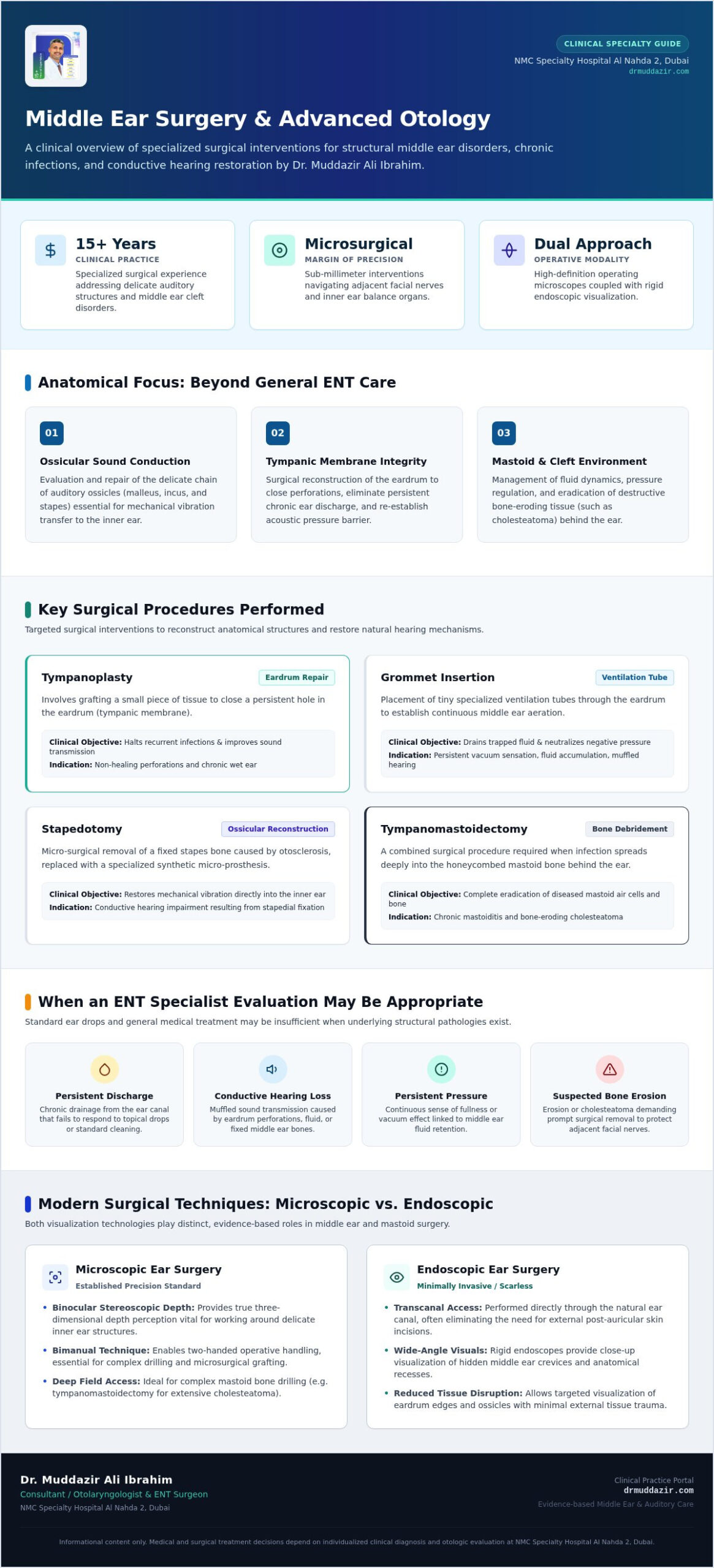
A middle ear surgery specialist is a consultant otolaryngologist who focuses on the intricate medical and surgical management of the auditory system. While a general ENT physician addresses a broad range of conditions affecting the throat and nose, a specialist in this field dedicates their practice to the delicate structures behind the eardrum. This role requires a sophisticated understanding of the ossicles, the tiny bones responsible for sound conduction, and the complex mucosal environment of the middle ear cleft. It’s a discipline where clinical authority meets microscopic precision to restore a patient’s quality of life.
The primary focus areas for such a specialist include hearing restoration, the management of chronic infections, and the repair of structural defects. Achieving successful outcomes in otologic surgery depends heavily on the use of specialized instrumentation. High-definition microscopes and rigid endoscopes provide the visualization necessary to navigate spaces measured in millimeters. For patients visiting an ear specialist in Dubai, this level of technological integration ensures that even the most subtle pathologies are identified and treated with accuracy.
The Role of an Otolaryngologist in Ear Care
Otolaryngologists manage both the clinical and surgical aspects of ear health. In many cases, a patient’s journey begins with conservative treatments such as topical drops or specialized cleaning for external infections. However, when symptoms like persistent discharge or progressive hearing loss don’t respond to medical management, a general ENT may refer the patient to a middle ear surgery specialist. This transition is essential when the underlying cause involves structural issues like a perforated eardrum or bone erosion from a cholesteatoma. The clinical expertise required here involves a deep understanding of how fluid dynamics and pressure regulation within the ear affect overall hearing clarity.
Advanced Training in Micro Ear Surgery
Performing surgery on the ear’s internal structures isn’t a standard skill; it’s a refined craft developed through years of focused experience. Dr. Muddazir Ali Ibrahim brings over 15 years of clinical experience to these procedures at NMC Specialty Hospital Al Nahda 2, Dubai. This advanced training is necessary because the margin for error in the middle ear is virtually zero. Surgeons must master the use of micro-drills and laser technology to work around the facial nerve and the inner ear’s sensitive balance organs. Whether performing basic interventions or advanced micro ear surgery in Dubai, the specialist’s goal remains the same: to stabilize the ear and optimize the patient’s auditory potential through meticulous, evidence-based techniques.
Key Procedures Performed by an Ear Specialist
Middle ear procedures are highly specialized interventions that address both structural integrity and functional hearing. When you consult a middle ear surgery specialist, the focus is on precise repairs that standard medical treatments cannot achieve. These surgeries are often necessary when a patient experiences persistent symptoms that indicate internal damage, such as a perforated eardrum or bone erosion. At NMC Specialty Hospital Al Nahda 2, Dubai, these procedures are performed using advanced visualization to ensure the best possible outcomes for auditory health.
Common procedures include:
- Tympanoplasty: This involves grafting a small piece of tissue to close a hole in the eardrum. It’s often essential for stopping recurrent infections and improving sound conduction.
- Grommet Insertion: Often used for pressure equalization, these tiny ventilation tubes help drain fluid and prevent the vacuum effect that causes pain and muffled hearing.
- Tympanomastoidectomy: A more complex procedure used when infection has spread into the mastoid bone behind the ear, requiring the removal of diseased bone and tissue.
Hearing Restoration and Auditory Reconstruction
The goal of many reconstructive middle ear procedures is to restore the natural conduction of sound. Conditions like otosclerosis, where the stapes bone becomes fixed and cannot vibrate, require a specialized intervention called a stapedotomy. In this procedure, the specialist replaces the immobile bone with a micro-prosthesis. This restores the vibration needed for sound to reach the inner ear effectively. If you’re experiencing conductive hearing loss, you might find more detailed information in our hearing restoration surgery guide. These reconstructions are delicate and require the steady hand of a seasoned professional to ensure the tiny prosthetic is positioned with sub-millimeter accuracy.
Managing Chronic Ear Diseases
Chronic ear disease often manifests as persistent discharge or “wet” ears that don’t stay dry despite antibiotic use. A middle ear surgery specialist evaluates these cases to determine if surgical clearance is necessary to prevent long-term complications such as meningitis or facial nerve paralysis. In advanced cases, a tympanomastoidectomy is performed to remove infected tissue and cholesteatoma, a non-cancerous but destructive skin growth. By addressing these issues early, Dr. Muddazir Ibrahim helps patients avoid the progressive bone destruction that leads to permanent hearing loss. If you’re concerned about recurring infections, a professional consultation can help determine the most appropriate surgical path forward for your specific condition.
When to Seek a Specialist Evaluation
Many patients find themselves in a cycle of recurring infections that seem to clear up with antibiotics only to return weeks later. If you’re experiencing symptoms that don’t resolve with standard care, a middle ear surgery specialist can determine if the issue is structural rather than purely medical. You should consider a specialized evaluation if you notice:
- Persistent hearing loss that doesn’t improve after an infection clears.
- Chronic ear discharge, especially if it has a foul odor.
- A feeling of constant pressure or “fullness” in one ear.
- Dizziness or a sense of unsteadiness during an ear infection flare-up.
While a primary care physician can treat an acute earache, specialized intervention is needed when the underlying anatomy is compromised. Persistent hearing loss often suggests that the sound-conducting bones or the eardrum itself have sustained damage that requires surgical repair. Ignoring these signs can lead to a progressive decline in your hearing that becomes much harder to reverse later.
Warning Signs of Middle Ear Pathology
Identifying the difference between a simple infection and a condition requiring surgery is crucial. A simple infection usually resolves with medication, but surgical conditions often involve structural changes. For instance, a perforated eardrum that fails to heal on its own can leave the middle ear vulnerable to repeated contamination from water or bacteria. Another serious concern is a cholesteatoma, which is an abnormal skin growth behind the eardrum. If left untreated, it can erode the delicate bones of the ear and even lead to facial weakness. Consulting an ear specialist in Dubai allows for a detailed assessment of these pathologies through high-definition visualization. In these cases, an ENT evaluation may be appropriate to prevent further bone erosion.
The Diagnostic Process
When you visit Dr. Muddazir Ibrahim at NMC Specialty Hospital Al Nahda 2, Dubai, the diagnostic process is thorough and patient-focused. It begins with a microscopic ear examination, which provides much greater detail than a standard handheld otoscope. The specialist may also use diagnostic nasal endoscopy to evaluate the Eustachian tube, as nasal health often impacts ear pressure and drainage. You’ll likely undergo audiometry to quantify the degree of hearing loss and tympanometry to check eardrum mobility. It’s vital to remember that treatment depends on the underlying cause. Some patients may only need specialized cleaning under a microscope, while others might require advanced micro ear surgery to prevent complications like dizziness or balance issues. These symptoms often arise when an infection begins to affect the inner ear’s vestibular system, making a prompt evaluation a priority for your long-term health and stability.
Choosing an ENT Surgeon for Middle Ear Procedures in Dubai
Selecting a middle ear surgery specialist involves more than just verifying a title. It requires evaluating a surgeon’s specific history with delicate auditory reconstructions and their ability to navigate the unique anatomy of the ear. For patients in the Dubai and Sharjah border region, finding high-level surgical care shouldn’t mean enduring long, stressful commutes. Dr. Muddazir Ali Ibrahim provides this specialized care at NMC Specialty Hospital Al Nahda 2, Dubai, making advanced treatment highly accessible for those living in Al Nahda, Al Qusais, Muhaisnah, and Deira.
Geographic convenience is a practical factor that supports your recovery. Post-operative care often requires multiple follow-up visits for cleaning and monitoring. Choosing a facility that’s easy to reach from Sharjah or Al Nahda ensures that you don’t miss these vital appointments due to traffic or distance. This proximity, combined with the clinical authority of an established hospital, creates a secure environment for your hearing health journey.
Clinical Expertise and Patient Outcomes
Surgical volume and experience are key indicators of a surgeon’s proficiency. When you’re dealing with structures as small as the middle ear bones, every millimeter matters. Dr. Muddazir Ibrahim brings over 15 years of clinical experience to these complex cases. It’s essential to choose a specialist who doesn’t just perform the surgery but also takes the time to explain the procedure in plain English. This patient-focused approach ensures you understand the “why” behind the surgical plan, whether it involves microscopic precision or endoscopic flexibility. A reassuring and compassionate consultation style helps lower the anxiety often associated with ear surgery, allowing you to focus on your recovery.
Hospital Facilities and Technology
The success of middle ear surgery is closely tied to the technology available in the operating theater. NMC Specialty Hospital Al Nahda 2 is equipped with advanced high-definition microscopes and rigid endoscopes. These tools allow the surgical team to visualize hidden recesses of the ear that might be missed with older equipment. Beyond the technology, the quality of the supporting surgical team and the post-operative nursing care are critical components of a safe outcome. For a broader look at selecting the right provider for your needs, you can explore our guide on an ENT specialist Dubai everything you need to know. Having a dedicated team that understands the specific requirements of ear surgery patients makes a significant difference in the overall experience. If you’re ready to take the next step toward better hearing, you can book a consultation at our Dubai location to discuss your specific needs.
Modern Techniques: Microscopic vs. Endoscopic Ear Surgery
A middle ear surgery specialist doesn’t just pick a tool based on preference; they choose the one that offers the highest safety margin for your specific condition. Modern ear surgery has evolved from a one-size-fits-all approach into a highly tailored discipline. Today, surgeons have the choice between the traditional operating microscope and the advanced high-definition endoscope. While both technologies aim to restore hearing and eliminate disease, they offer different advantages depending on the patient’s anatomy and the nature of the ear pathology. In many complex cases, a hybrid approach is used to ensure no area of infection is left behind.
The decision-making process is entirely evidence-based. Your specialist will evaluate the size of the ear canal, the location of the disease, and whether bone drilling is required before recommending a specific method. This ensures that the intervention is as minimally invasive as possible while remaining thorough enough to prevent recurrence.
Benefits of Endoscopic Scarless Ear Surgery
Endoscopic ear surgery represents a major shift toward minimally invasive care in Dubai. By using thin, rigid tubes equipped with high-definition cameras, the surgeon can operate directly through the natural ear canal. This often removes the need for a post-auricular incision, which is the traditional cut made behind the ear. This “scarless” approach provides a wide-angle view, allowing the specialist to see “around the corners” into hidden recesses like the sinus tympani.
Patients often find that endoscopic methods lead to less post-operative discomfort. Because there’s no external wound, the healing process is typically focused on the internal graft and mucosal recovery. If you’re interested in how this technology works, you can read all about endoscopic ear surgery to understand its role in modern ENT care. It’s an excellent option for many tympanoplasty procedures where the disease is limited to the middle ear space.
The Precision of Microscopic Ear Intervention
The operating microscope remains the gold standard for many advanced ear reconstructions. Its greatest strength is stereoscopic vision, which provides the surgeon with three-dimensional depth perception. This depth is vital when working near the facial nerve or when replacing the tiny bones of hearing with prosthetics. Since the microscope is a hands-free, floor-mounted unit, it allows the surgeon to use a two-handed technique. This is essential when drilling the mastoid bone or managing heavy bleeding that might obscure an endoscope’s lens.
Post-operative expectations for microscopic surgery often include a standard recovery period where the incision behind the ear needs time to heal. It’s important to follow enhanced post-operative instructions after micro ear surgery to ensure the graft remains stable. While the recovery might be slightly different than the scarless approach, the microscopic method provides the stability and magnification needed for the most complex structural repairs. Your middle ear surgery specialist will guide you through the choice that best supports your long-term hearing health and safety.
Taking the Next Step Toward Clearer Hearing
Understanding your options is the first step toward resolving persistent ear issues and reclaiming your quality of life. Whether your condition requires the high-magnification precision of microscopic intervention or the minimally invasive benefits of endoscopic scarless ear surgery, the most effective approach depends on a thorough, evidence-based clinical assessment. Specialized care focuses on more than just temporary relief; it aims to restore the delicate structural integrity and sound-conduction capabilities of your auditory system.
As a middle ear surgery specialist, Dr. Muddazir Ali Ibrahim brings over 15 years of clinical experience to every patient encounter. By utilizing the advanced surgical facilities at NMC Specialty Hospital Al Nahda 2, Dubai, he provides compassionate, patient-focused care that is easily accessible to families across Al Nahda Dubai, Sharjah, and Al Qusais. You don’t have to manage muffled hearing or recurring infections on your own.
For a specialized evaluation of your ear health, book a consultation with Dr. Muddazir Ali Ibrahim at NMC Specialty Hospital Al Nahda 2, Dubai. Restoring your hearing and protecting your long-term health is a journey we are ready to navigate with you.
Frequently Asked Questions
What is a middle ear surgery specialist called?
A middle ear surgery specialist is officially known as an Otolaryngologist or an ENT Surgeon with advanced training in otology. These specialists focus on the medical and surgical management of the ear, including the eardrum and the tiny sound-conducting bones. At NMC Specialty Hospital Al Nahda 2, Dubai, Dr. Muddazir Ali Ibrahim provides this specialized care, utilizing microscopic and endoscopic techniques to address complex auditory conditions for patients across Al Nahda and Sharjah.
When is middle ear surgery required for hearing loss?
Surgical intervention may be appropriate when hearing loss is caused by structural issues in the middle ear that don’t respond to medicine. This often includes a perforated eardrum, damage to the ossicles, or abnormal bone growth like otosclerosis. If sound cannot reach the inner ear effectively due to these physical barriers, a specialist might recommend reconstructive procedures to restore the natural conduction of sound and improve your overall hearing clarity.
What is the difference between tympanoplasty and mastoidectomy?
Tympanoplasty is a procedure focused on repairing a hole in the eardrum or performing reconstructive work on the small hearing bones. In contrast, a mastoidectomy is performed to remove infected tissue or diseased bone from the mastoid cavity behind the ear. While a tympanoplasty aims to improve hearing and prevent discharge, a mastoidectomy is primarily a safety procedure used to eliminate chronic infections that could potentially spread to surrounding structures.
Is middle ear surgery painful or risky?
Most middle ear procedures are performed under general or local anesthesia, so patients don’t feel pain during the surgery. Post-operative discomfort is typically managed with prescribed medication. While all surgeries carry some level of risk, such as infection or changes in taste, a specialized ENT surgeon uses high-definition visualization to minimize these possibilities. The specific risk profile depends on the underlying cause and the complexity of the ear’s internal anatomy.
How long is the recovery period after micro ear surgery?
The recovery period after ear surgery varies significantly depending on the specific procedure performed and the patient’s individual healing process. During the initial phase, an ENT specialist typically advises patients to avoid water entry into the ear and limit certain physical activities. Dr. Muddazir Ibrahim provides personalized post-operative guidance to ensure the surgical graft remains stable. Regular follow-up appointments are necessary to monitor progress and determine when it is safe to resume normal daily routines.
Can middle ear surgery restore hearing completely?
Hearing restoration depends on the underlying cause and the health of the inner ear. If the hearing loss is conductive, meaning sound is simply blocked by a structural issue, surgery can often result in significant improvement. However, if there is nerve damage or sensorineural loss, surgical intervention may not fully restore hearing. A thorough evaluation by a specialist is necessary to set realistic expectations based on your specific diagnostic results and auditory health.
Where can I find a middle ear surgery specialist in Dubai?
You can find a middle ear surgery specialist at NMC Specialty Hospital Al Nahda 2, Dubai. Dr. Muddazir Ali Ibrahim is a Consultant ENT Surgeon with over 15 years of clinical experience specializing in advanced ear procedures. His practice is conveniently located for patients in Al Nahda Dubai, Al Nahda Sharjah, Al Qusais, and Deira. This central location ensures that residents across the Dubai and Sharjah border have access to specialized microscopic and endoscopic ear treatments.