
What if the silence you’re experiencing isn’t a permanent loss, but a mechanical hurdle that can be precision-engineered back to life? For many people living with otosclerosis in Dubai, the world slowly grows quiet as a tiny bone in the middle ear stops moving; however, this doesn’t have to be your permanent reality. Stapedectomy surgery offers a sophisticated way to bypass this blockage and reclaim the clarity you’ve lost. It’s a precise micro-ear intervention designed to restore the natural flow of sound, allowing you to engage with the world without the constant frustration of external hearing aids.
We understand how isolating it feels when you can’t follow a conversation in a crowded restaurant or when you feel disconnected from your surroundings. You’re likely searching for a solution that feels more natural and less intrusive than a battery-operated device. In this guide, you’ll discover how advanced micro-ear surgery can effectively address conductive hearing loss. We’ll explore the specialized process performed by Dr. Muddazir Ali Ibrahim at NMC Specialty Hospital Al Nahda 2, Dubai, and explain how this procedure can help you return to a life of clear, natural sound.
Key Takeaways
- Understand how stapedectomy surgery addresses hearing loss caused by otosclerosis by replacing a fixed middle-ear bone with a specialized prosthesis.
- Compare the clinical differences between traditional stapedectomy and modern stapedotomy to determine which micro-ear intervention best suits your needs.
- Weigh the long-term benefits of surgical hearing restoration against the daily maintenance and environmental challenges associated with external hearing aids.
- Learn what to expect during the recovery period, including essential steps to protect your ear in the critical days following your procedure.
- Explore the advanced surgical environment and compassionate care offered by Dr. Muddazir Ibrahim at NMC Specialty Hospital Al Nahda 2 in Dubai.
What is Stapedectomy Surgery and How Does it Restore Hearing?
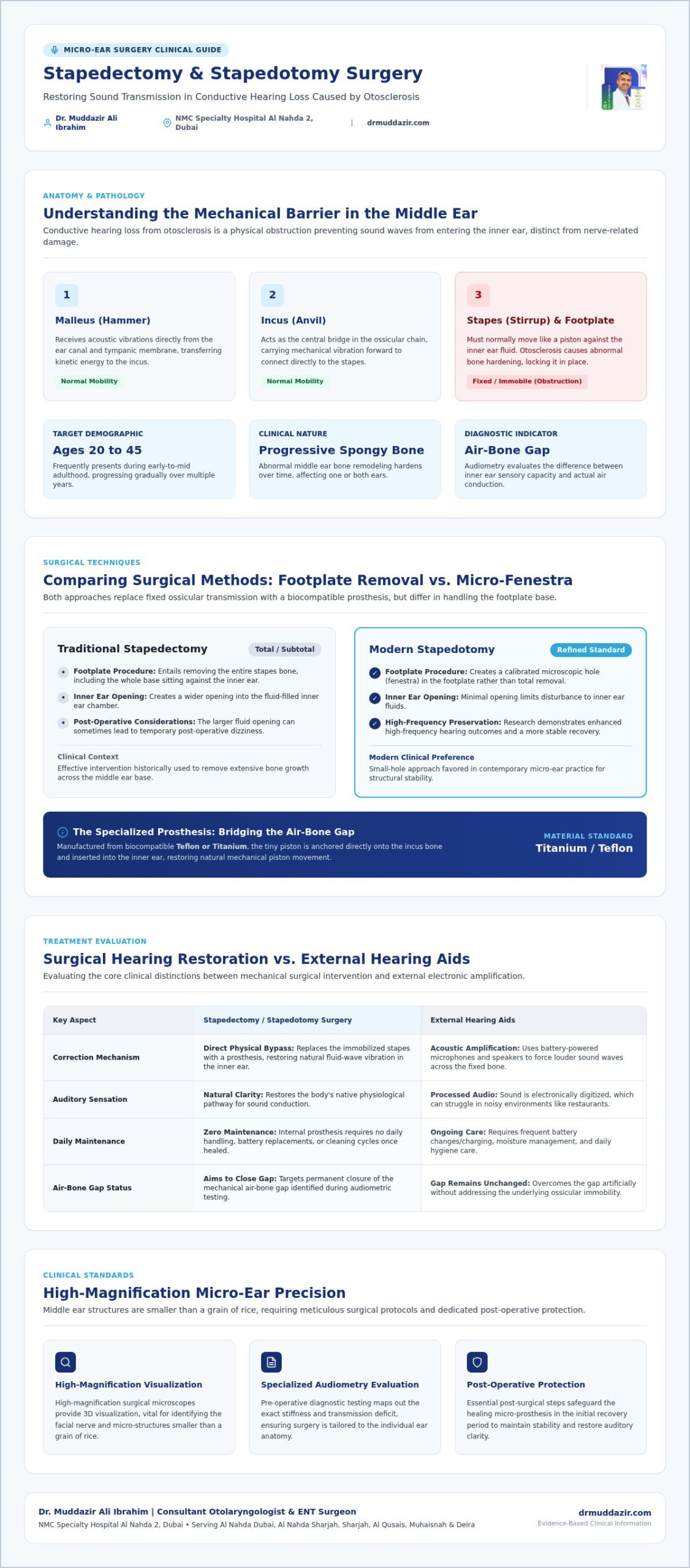
Stapedectomy surgery is a specialized micro-ear surgery performed to correct a specific type of hearing impairment. To understand how it works, we must look at the middle ear’s anatomy. Sound travels through the ear canal, moving three tiny bones: the malleus, the incus, and the stapes. The stapes, or stirrup, must move like a piston to push sound waves into the inner ear. If it becomes stuck, sound cannot pass through effectively. This mechanical failure is what surgeons address during a stapedectomy.
This procedure is distinct from treatments for nerve-related hearing loss, where damage lies in the inner ear or brain. Conductive hearing loss is a physical obstruction. Stapedectomy surgery restores movement, allowing sound to flow freely again. This intervention is often the most effective way to address the physical cause of the hearing deficit. By bypassing the immobile bone, patients can regain the clarity of sound that has been missing for years.
Understanding the Mechanics of Otosclerosis
The primary condition necessitating this surgery is otosclerosis. This involves abnormal bone remodeling in the middle ear where healthy bone is replaced by a spongy growth that eventually hardens. When this growth affects the stapes footplate, the bone loses its ability to vibrate. It’s a progressive condition that can affect one or both ears, often appearing in young adults between 20 and 45.
Many patients in Dubai, including those in Al Nahda and Sharjah, find their hearing loss worsens over several years. It’s often overlooked until it interferes with conversations in noisy environments. A specialized ENT evaluation can identify the specific stiffness of the middle ear bones through audiometry. Early diagnosis is vital because it allows patients to explore surgical options before the hearing loss significantly impacts their daily life.
The Goal of Surgical Intervention
The main objective of the stapedectomy procedure is to bridge the gap between the middle and inner ear. During the operation, the surgeon removes the diseased portion of the stapes. A tiny hole is made in the footplate to accommodate a prosthesis. This device, often made of biocompatible Teflon or titanium, is attached to the incus bone and inserted into the inner ear, effectively bypassing the fixed bone and restoring the chain of vibration.
By restoring this piston movement, the surgery aims to close the air-bone gap. This is the difference between your inner ear’s potential and what you actually perceive through the air. Successful intervention can lead to a dramatic restoration of natural hearing. For many, this means no longer needing to manage the maintenance and batteries of external hearing aids. Dr. Muddazir Ibrahim focuses on this precision to help patients at NMC Specialty Hospital Al Nahda 2, Dubai, achieve clear auditory outcomes.
Comparing Stapedotomy and Stapedectomy Techniques
Historically, stapedectomy surgery involved removing the entire stapes bone, including the base or “footplate” that sits against the inner ear. While effective, removing the whole footplate creates a larger opening into the fluid-filled inner ear, which can sometimes lead to temporary post-operative dizziness. Modern clinical practice has largely shifted toward stapedotomy. In this refined technique, the surgeon creates a microscopic hole, or fenestra, in the footplate rather than removing it entirely. Researching stapes surgery techniques and outcomes shows that this “small-hole” approach often results in better high-frequency hearing and a more stable recovery for the patient.
Both methods rely on a specialized prosthesis to bridge the gap. Once the fixed bone is addressed, a tiny piston is placed to connect the remaining middle ear bones to the inner ear. This restoration of the physical connection is what allows sound to travel through the ear again. Choosing between these techniques depends on the specific anatomy and the extent of the bone growth found during the procedure. It’s a decision made with precision to ensure the best possible auditory result.
The Role of Micro Ear Surgery Excellence
Navigating the middle ear requires extreme precision because the structures involved are smaller than a grain of rice. To achieve this, surgeons use high-magnification microscopes that provide a clear, three-dimensional view of the surgical field. This level of detail is essential for identifying the facial nerve and other delicate landmarks nearby. When performing Micro Ear Surgery in Dubai, Dr. Muddazir Ibrahim utilizes these advanced visualization tools to ensure the prosthesis is placed with sub-millimeter accuracy. This meticulous approach at NMC Specialty Hospital Al Nahda 2 helps minimize trauma to the surrounding tissues.
Prosthesis Materials and Sound Transmission
The implants used in modern middle ear surgery are masterpieces of bioengineering. They’re typically crafted from biocompatible materials that the body accepts long-term. Common materials include:
- Titanium: Prized for being incredibly light and strong, providing excellent sound conduction.
- Teflon (Fluoroplastic): Often used for the piston part because of its durability and smooth movement.
- Stainless Steel: A traditional, reliable choice for certain types of ossicular reconstruction.
These materials are chosen because they’re light enough to mimic the natural vibration of the original ear bones. Modern implants are designed to last a lifetime, meaning most patients won’t need a replacement. They’re also MRI-compatible, which is a vital consideration for your future health monitoring. If you’re noticing a gradual decline in your hearing, arranging a clinical assessment can help determine if these advanced surgical options are suitable for your specific condition.
Hearing Aids vs. Stapedectomy: Which Path is Right for You?
Choosing between a hearing aid and stapedectomy surgery is a significant decision for anyone managing conductive hearing loss. Hearing aids provide a non-invasive way to amplify sound, which can be effective for many patients. However, they don’t address the underlying mechanical issue of the fixed stapes bone. Instead, they rely on increasing the volume of sound waves entering the ear. While modern digital aids are sophisticated, they still require daily maintenance, battery changes, and can feel uncomfortable in the humid climate of Dubai or during outdoor activities in Al Nahda.
In contrast, stapes surgery for otosclerosis aims to restore the ear’s natural hearing mechanism. Rather than amplifying sound through an external device, the surgery reconstructs the ossicular chain. This often results in a more natural sound quality and improved clarity, especially when trying to follow conversations in noisy environments like a busy Deira market or a social gathering in Muhaisnah. For many, the elimination of a physical device is the primary motivation for choosing a surgical path.
Pros and Cons of Surgical Restoration
The most compelling benefit of stapedectomy surgery is its potential as a permanent solution. Once the prosthesis is in place, it functions without the need for external power or adjustments. It’s particularly beneficial for active individuals who find hearing aids restrictive. However, surgery does involve risks that must be weighed carefully. Some patients experience a temporary disturbance in taste or a period of post-operative dizziness. While these are usually short-lived, understanding these possibilities is essential. It’s helpful to consult an ENT Specialist in Dubai for a personal assessment of your candidacy.
Decision Factors for Patients
Several factors influence which path is right for you. Your audiometry results are the starting point; they show the degree of the “air-bone gap” and whether your inner ear is healthy enough to benefit from surgery. Younger patients often prefer surgery to avoid decades of hearing aid costs and maintenance. Conversely, those with certain medical contraindications might find amplification a safer choice. If you’re feeling uncertain, seeking a second opinion is a standard and responsible step. You can refer to the ENT Surgery Buyers Guide to help structure your questions during a consultation with Dr. Muddazir Ibrahim at NMC Specialty Hospital Al Nahda 2, Dubai.
Recovery Timeline and Post-Surgical Expectations
Once the decision for stapedectomy surgery is made, understanding the path to recovery is the next step in your hearing restoration journey. After the procedure, your primary goal is to protect the delicate microscopic work performed in the middle ear. You’ll wake up with specialized packing in the ear canal, which provides essential support to the new prosthesis. It’s common for hearing to feel muffled or “liquid” during this time; this isn’t a sign of failure but a result of the packing and normal surgical swelling.
The first 48 hours are the most critical for stabilization. You should avoid any sudden head movements, as these can trigger temporary vertigo while the inner ear adjusts to the intervention. Rest is essential. Most patients are able to return to light activities within a few days, but the internal healing continues for several weeks as the tissue around the prosthesis matures.
Activity restrictions focus on preventing pressure changes within the head. You must avoid lifting heavy objects, straining, or bending over. If you need to sneeze, do so with your mouth open to vent pressure safely. Forceful nose blowing is prohibited for several weeks, as it can displace the tiny piston before it has fully settled into its precise position.
Managing Recovery in the Dubai Climate
Dubai’s environmental factors, such as high humidity and intense heat, require extra vigilance during your recovery. Excessive perspiration can lead to moisture entering the ear canal, which may increase the risk of infection. It’s best to stay in climate-controlled environments during the initial healing phase to keep the surgical site dry. Patients living in Al Nahda or Sharjah find the location of NMC Specialty Hospital Al Nahda 2 convenient for the essential follow-up visits where Dr. Muddazir Ibrahim removes the packing and monitors the healing eardrum.
Air travel is a major consideration for UAE residents and expatriates. You should avoid flying for at least three to four weeks post-surgery. The rapid pressure fluctuations in an aircraft cabin can damage the healing eardrum or shift the prosthesis, potentially compromising the surgical outcome. Planning your procedure around your travel schedule is a vital part of the consultation process.
Post-Operative Care Instructions
Protecting the ear from water during showers is vital for a successful recovery. A cotton ball saturated with petroleum jelly placed in the outer ear usually provides a sufficient seal. You shouldn’t submerge your head in water or go swimming until your surgeon confirms the eardrum has fully healed. For more specific guidance on daily care, you can read the Enhanced Post-Operative Instructions After Micro Ear Surgery.
While complications are rare, certain symptoms require immediate attention. If you experience severe, persistent dizziness, a sudden loss of hearing, or significant pain, contact our clinical team immediately for a professional evaluation. Final hearing clarity typically emerges six to eight weeks after the procedure as the swelling subsides and the ear fully heals.
Expert Micro Ear Surgery at NMC Specialty Hospital Al Nahda 2
Dr. Muddazir Ibrahim’s clinical practice at NMC Specialty Hospital Al Nahda 2 is built on a foundation of precision and patient-focused empathy. When you’re facing the challenges of progressive hearing loss, you need more than just a technical solution; you need a guide who understands the impact on your daily life. The hospital provides a sophisticated surgical environment equipped with the latest high-magnification microscopes. These tools are essential for the sub-millimeter accuracy required during stapedectomy surgery. This facility serves a diverse patient population across Dubai, offering a central point of care for those living in Al Qusais, Deira, and Muhaisnah, as well as residents in Sharjah.
The diagnostic process at our center is comprehensive. We don’t rely on symptoms alone; instead, we utilize advanced audiology to map your hearing profile and microscopic evaluation to inspect the physical health of the middle ear. This evidence-based approach ensures that any recommendation for surgical intervention is grounded in clear clinical data. Whether you’re experiencing a mild conductive gap or more significant loss, our team is dedicated to finding the most effective way to restore your auditory clarity.
A Personalized Path to Hearing Restoration
Every patient’s ear anatomy is unique. Dr. Muddazir Ibrahim prioritizes a detailed pre-surgical consultation to explain the specific nuances of your case. During these sessions, you’ll discuss the different surgical variants and what they mean for your specific recovery. While traditional microscopic approaches remain the gold standard for stapes work, Dr. Muddazir also utilizes minimally invasive techniques where appropriate, such as Endoscopic Ear Surgery. This commitment to modern, patient-centered methods ensures that you feel secure and well-informed before proceeding with any intervention. Clear communication is at the heart of our practice, helping to alleviate the anxiety that often accompanies ear surgery.
Booking Your Evaluation in Dubai
Scheduling your initial evaluation is a straightforward process. During this visit, Dr. Muddazir Ibrahim will perform a thorough examination and review your audiometry results to confirm if stapedectomy surgery is the most appropriate path for your hearing restoration. Our clinic at NMC Specialty Hospital Al Nahda 2 is positioned to provide convenient access for residents across Dubai and the Northern Emirates. We focus on providing a seamless experience from your first diagnostic test through to your final post-operative check-up. Taking the first step toward Hearing Restoration Surgery can be the beginning of regaining your connection to the world of sound. Don’t let hearing loss limit your experiences; professional help is available right here in Dubai.
Reclaiming Your Connection to Sound
The journey toward clearer hearing begins with understanding that your loss may be a treatable mechanical issue rather than a permanent decline. By addressing the physical obstruction caused by otosclerosis, stapedectomy surgery provides a path to restored clarity and a life free from the daily maintenance of external devices. We’ve explored how modern micro-surgical techniques allow for sub-millimeter precision and a structured recovery, ensuring you feel secure at every stage of the process.
Choosing a specialized guide is essential for achieving the best possible auditory results. Dr. Muddazir Ali Ibrahim, a Consultant ENT Surgeon at NMC Specialty Hospital Al Nahda 2, Dubai, focuses on these advanced micro-ear procedures with a patient-centered approach. Whether you live in Al Nahda, Sharjah, or Deira, expert clinical evaluation is conveniently accessible. You don’t have to settle for muffled conversations; professional intervention can help you reconnect with the world of sound you’ve been missing. Schedule a Consultation with Dr. Muddazir Ibrahim today to take the first step toward hearing restoration.
Frequently Asked Questions
Is stapedectomy surgery considered a major procedure?
Stapedectomy surgery is a sophisticated micro-ear procedure that requires specialized expertise. While it’s often performed as a day-case or with a short hospital stay, it’s considered a delicate intervention because it involves working with the smallest bones in the human body. The use of high-magnification microscopes at NMC Specialty Hospital Al Nahda 2 ensures the highest level of precision. Most patients find the physical recovery relatively quick compared to other surgical interventions.
How long does the hearing improvement last after a stapedectomy?
For the majority of patients, the hearing restoration achieved through this procedure is permanent. The artificial prosthesis is made from biocompatible materials like Teflon or titanium, which are designed to function for a lifetime without needing replacement. While the mechanical correction of the middle ear remains stable, it’s important to have regular follow-ups in Dubai to monitor your overall auditory health as you age or if otosclerosis affects other areas.
Can stapedectomy surgery be performed on both ears at the same time?
Surgeons typically don’t perform this procedure on both ears simultaneously. A staged approach is much safer, usually allowing for a gap of several months between surgeries. This ensures that the first ear has completely healed and the hearing has stabilized before proceeding with the second. This cautious method helps maintain your balance and ensures that you have one functioning ear throughout the entire recovery process in Al Nahda.
What are the most common risks associated with stapes surgery?
Like any surgical intervention, stapes surgery carries specific risks that Dr. Muddazir Ibrahim will discuss with you. These may include temporary dizziness or a metallic taste in the mouth due to the proximity of the taste nerve. There is also a very small risk of persistent hearing loss or tinnitus. Most of these side effects are short-lived, and our clinical team provides comprehensive post-operative support to manage your comfort during the healing phase.
How soon can I return to work after stapedectomy surgery in Dubai?
Most patients can return to sedentary office work within one to two weeks after the procedure. However, if your job involves heavy lifting, straining, or exposure to significant pressure changes, a longer period of rest may be appropriate. Residents of Muhaisnah and Deira should factor in the need to avoid strenuous activity during the initial healing weeks. We provide individualized guidance based on your specific occupation and the progress of your recovery.
Will I still need a hearing aid after the surgery is completed?
The primary objective of stapedectomy surgery is to restore natural hearing and eliminate the need for external amplification. Most successful procedures allow patients to follow conversations and enjoy sounds without a hearing aid. However, the final outcome depends on the health of your inner ear and the degree of nerve-related hearing loss present before the surgery. An ENT evaluation at our Dubai facility can help determine the likely results for your specific case.
What happens if otosclerosis is left untreated without surgery?
If left unaddressed, the hearing loss associated with otosclerosis usually progresses slowly over several years. While it rarely leads to total deafness, it can significantly hinder your ability to communicate in noisy environments or social settings. Choosing not to have surgery means you’ll likely rely on hearing aids for the rest of your life to manage the condition. A consultation in Al Qusais can help you weigh the benefits of surgical intervention versus non-surgical management.